
Patience in the Kitchen: Cooking as a Spiritual Offering
I’ve always loved cooking. Give me time, a quiet kitchen, and ingredients waiting to be transformed, and I can lose myself in the joy of creating something beautiful and nourishing. Cooking, in that sense, has always felt life-giving to me—almost like an art.
But that picture rarely matches my reality these days. More often, I’m cooking with a clock ticking loudly in my mind, children clamouring for snacks before the meal is ready, or voices piping up with “I don’t like that” before I’ve even set the plate down. Little C and Little M will sometimes be fighting over a toy in the corner, or climbing onto the table, or asking me a thousand questions as I try to chop vegetables without losing a finger. What once felt like a joy can quickly become a test of patience.
Cooking feels heavy some days. The kitchen is where needs collide—different appetites, constant demands, and the urgency of hunger. As mothers, it can feel like we’re holding it all together while standing over a pot that threatens to boil over.
And yet, Scripture reminds us in 1 Corinthians 10:31:
“So whether you eat or drink or whatever you do, do it all for the glory of God.”
This shifts the perspective. Cooking is not just about feeding mouths—it’s an act of service, of love, and yes, even of worship. The kitchen, with all its noise and mess, can become a place where we practice patience and choose to offer our work to God.
I’ve been learning to see cooking not only as another task on my list, but as a space where my faith can grow. Here are a few ways it’s helping me:
- Praying While Preparing: When I chop vegetables or stir a pot, I whisper prayers for the ones I’m feeding. It changes the meal from a task into a gift.
- Offering the Frustration: On the days when I feel stretched thin, I remind myself that even my frustration can be an offering: “Lord, I give this to You. Help me to serve with love, even here.”
- Embracing Imperfection: Not every meal is well-received, not every dinner feels peaceful. But learning to let go of control teaches me humility and reminds me that love is the true nourishment.
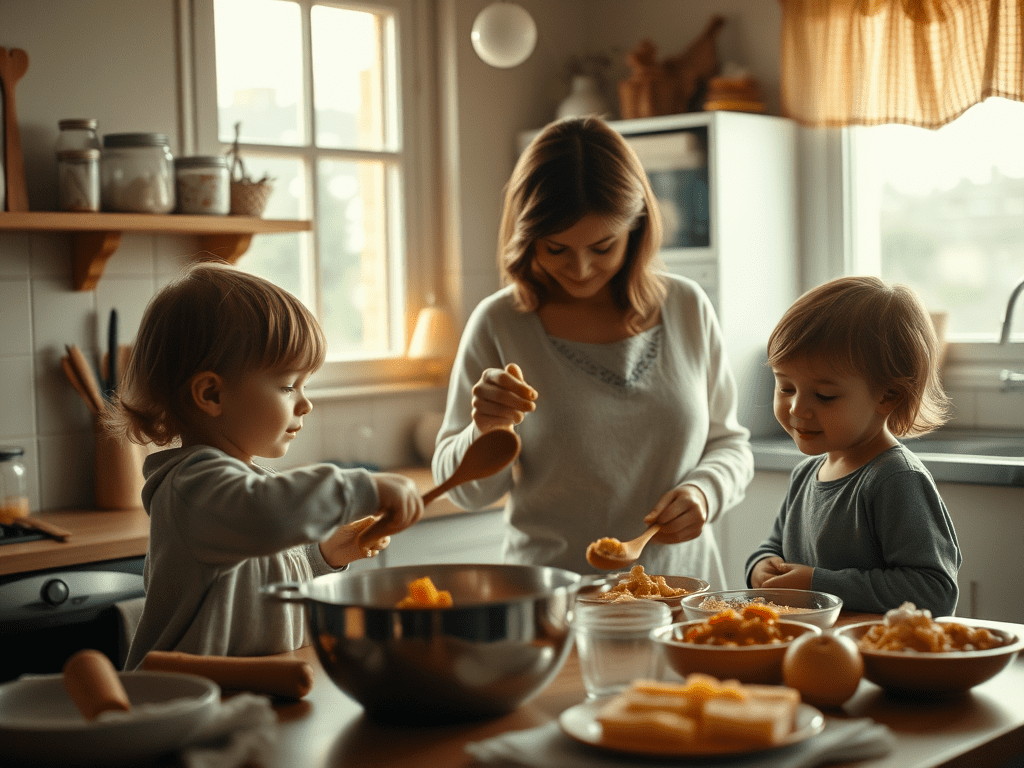
One other shift that has helped me is inviting my children into the kitchen. It doesn’t make cooking faster or neater—sometimes it doubles the mess—but it transforms the experience.
When Little C helps to stir or pour, she learns responsibility and pride in creating something for the family. When Little M stands beside me with a wooden spoon in hand, even if he’s only pretending, he feels part of the work. Including them slows me down, but it also turns cooking into connection.
It teaches them gratitude, reminds me to see the kitchen through their eyes, and often leads to conversations or laughter that make the chaos feel lighter. The kitchen becomes less of a battlefield and more of a classroom of love.
Cooking will always carry a tension for me—I love it in the quiet, but I live it in the chaos. And maybe that’s the point. The kitchen is where I am stretched, refined, and taught patience in ways I wouldn’t choose for myself.
Every meal becomes more than food—it becomes a daily reminder that love is best shown not in perfection, but in persistence. And when I choose to see the kitchen as a place of offering, even the noisy, messy, imperfect meals become a reflection of God’s grace.
If you haven’t yet, I invite you to explore the Faith in the Little Things devotional kit. It was created to help tired moms like us notice God’s presence in the middle of ordinary life—yes, even in the kitchen with little ones underfoot.
You can also receive a free set of Prayer Cards for Mothers here: Get Your Free Prayer Cards




Leave a Reply